Designing Care Strategy Creation for Healthcare Teams

Designing Care Strategy Creation for Healthcare Teams

Designing Care Strategy Creation for Healthcare Teams

How we transformed a technical, engineering-dependent workflow into an AI-assisted experience for care administrators - without compromising clinical governance.

How we transformed a technical, engineering-dependent workflow into an AI-assisted experience for care administrators - without compromising clinical governance.

How we transformed a technical, engineering-dependent workflow into an AI-assisted experience for care administrators - without compromising clinical governance.

Role

Associate Product Designer, Led AI design solo

Associate Product Designer, Led AI design solo

Team
Team

3 Engineers, 1 PM, 2 Designer

3 Engineers, 1 PM, 2 Designer

Timeline
Timeline

October, 25 - Present

October, 25 - Present

CONTEXT

CONTEXT

Healthcare organizations create care strategies to identify eligible patients, assign them to care managers, and trigger the right interventions. These strategies directly shape how care is delivered on the ground.

Yet creating them was slow, technical, and heavily dependent on Clinical Engineering teams - every change lived in raw JSON and every request became a ticket.

Healthcare organizations create care strategies to identify eligible patients, assign them to care managers, and trigger the right interventions. These strategies directly shape how care is delivered on the ground.

Yet creating them was slow, technical, and heavily dependent on Clinical Engineering teams - every change lived in raw JSON and every request became a ticket.

Healthcare organizations create care strategies to identify eligible patients, assign them to care managers, and trigger the right interventions. These strategies directly shape how care is delivered on the ground.

Yet creating them was slow, technical, and heavily dependent on Clinical Engineering teams - every change lived in raw JSON and every request became a ticket.

  1. Care Admin

Owns the strategy but couldn't build it. Depended on engineering for every change.

  1. Clinical Engineering

Translated intent into JSON. The bottleneck for every strategy, edit, and fix.

  1. Care Manager

Receives the patients a strategy assigns. Downstream of every decision made here.

  1. Patient

Indirectly impacted. Who qualifies and who's missed - is decided upstream.

How the strategy worked

Owned by care admins, built by engineers - fully understood by neither side at the same time.

Confidentiality Notice


To respect confidentiality agreements, certain visuals have been blurred or omitted. If you'd like to learn more, I'd be happy to walk you through the original screens, design decisions, and outcomes during 1:1 conversation.

PROBLEM

PROBLEM

The people who owned the strategy couldn't build it

The people who owned the strategy couldn't build it

Every care strategy lived in raw JSON. Changing a single eligibility rule meant filing an engineering ticket and waiting - while the care admins who owned the outcome had no way to see, question, or edit the logic assigning their own patients.

Owned by care admins, built by engineers - fully understood by neither side at the same time.

Every care strategy lived in raw JSON. Changing a single eligibility rule meant filing an engineering ticket and waiting - while the care admins who owned the outcome had no way to see, question, or edit the logic assigning their own patients.

Owned by care admins, built by engineers - fully understood by neither side at the same time.

What it cost-

~50/mo

~50/mo

Strategy-related support tickets to Customer Engineering

Strategy-related support tickets to Customer Engineering

0%

0%

Strategies authored by end users - every change went through engineering

Strategies authored by end users - every change went through engineering

Zero

Zero

Ability to test changes before they reached production

Ability to test changes before they reached production

Before
Before
After
After

GOAL

GOAL

Enable care admins to independently create accurate strategies using natural language while preserving clinical safety and existing workflows.

Enable care admins to independently create accurate strategies using natural language while preserving clinical safety and existing workflows.

THE EVOLUTION

THE EVOLUTION

Two phases. One problem, evolving

The work didn't add features - it moved the problem forward. First we solved who could build strategy. Then we solved the harder question underneath it: knowing what to build at all

The work didn't add features - it moved the problem forward. First we solved who could build strategy. Then we solved the harder question underneath it: knowing what to build at all

Phase 1

Making strategy creation accessible

Goal: Reduce dependency on Clinical Engineering by replacing JSON-based configuration with a visual workflow builder.

Goal: Reduce dependency on Clinical Engineering by replacing JSON-based configuration with a visual workflow builder.

Key Interface Decision

Key Interface Desicion

  1. Node-based canvas.

  1. Node-based canvas.

  1. Node-based canvas.

Every filter and rule becomes an addressable, debuggable step. Workflow logic becomes spatially legible.

  1. Validation gates the workflow.

  1. Validation gates the workflow.

  1. Validation gates the workflow.

Every node must validate before the user can move forward. Broken logic cannot reach dry run; broken dry runs cannot reach production. Errors surface at the node, not in production.
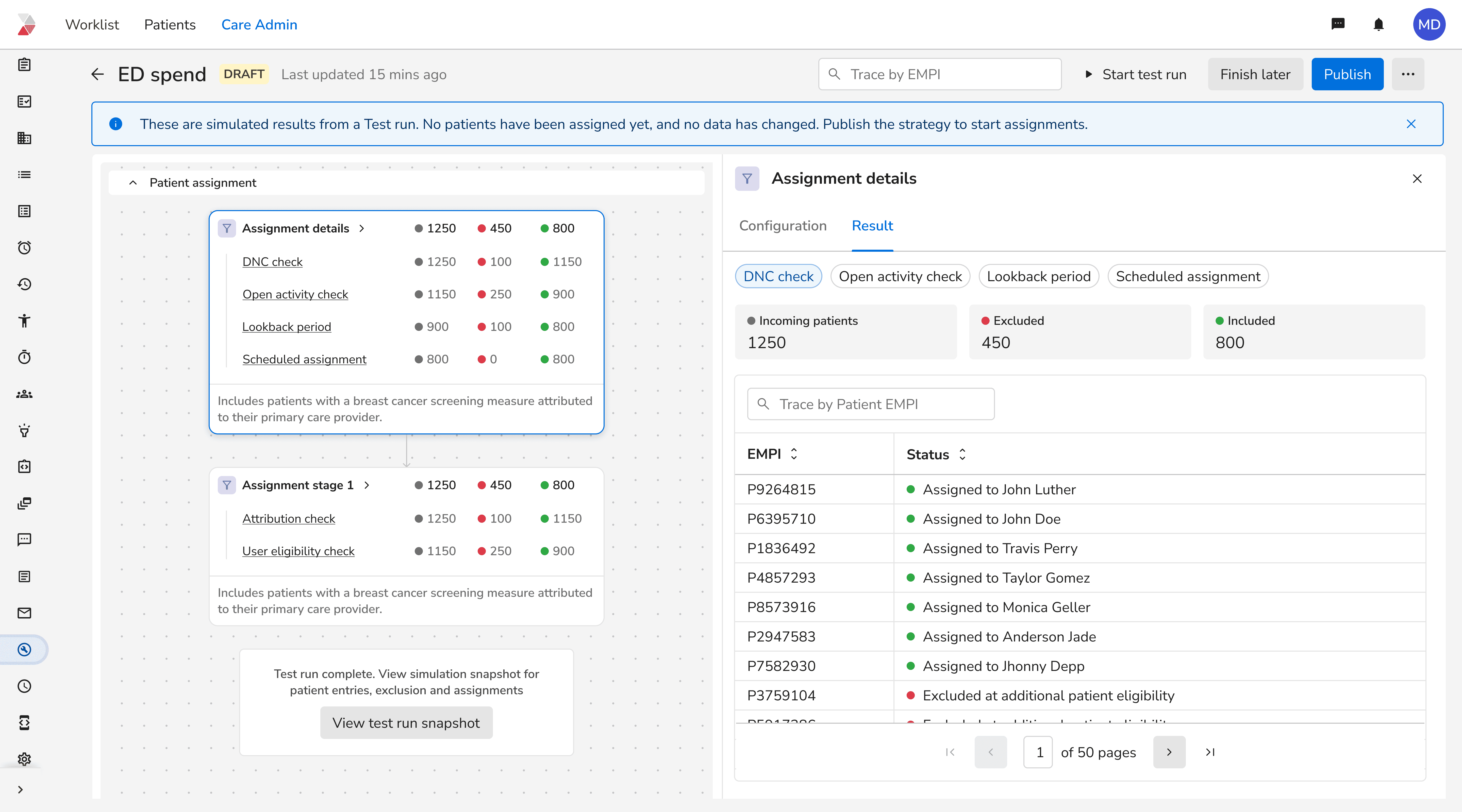
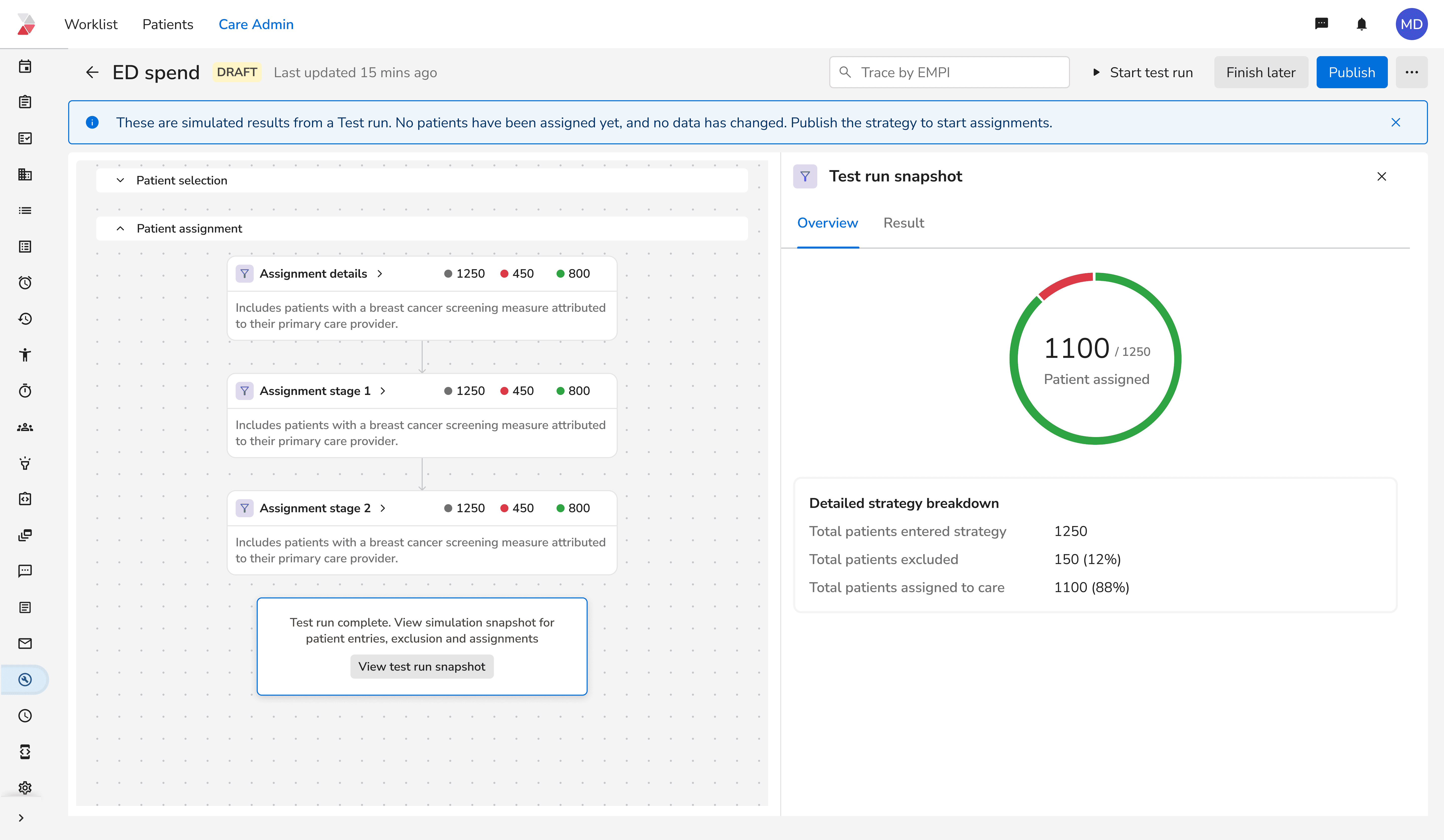
  1. Dry run with patient-level tracing.

  1. Dry run with patient-level tracing.

  1. Dry run with patient-level tracing.

Before publish, simulate the full strategy. See exactly which patients pass or fail at every rule. "Why was this patient excluded?" - once a support ticket - became self-serve.

Before publish, simulate the full strategy. See exactly which patients pass or fail at every rule. "Why was this patient excluded?" - once a support ticket - became self-serve.

So why wasn't this enough?

The visual builder solved the visibility problem. It didn't solve the cognitive one. That's where the AI work began - and where I started working solo.

The visual builder solved the visibility problem. It didn't solve the cognitive one. That's where the AI work began - and where I started working solo.

We made the interface easier - but the thinking was still difficult.

THE TURNING POINT

THE TURNING POINT


The Visual Builder solved how to build a strategy.
It didn't solve what to build.


The Visual Builder solved how to build a strategy.
It didn't solve what to build.

Care administrators could now configure workflows visually - but they still relied on institutional knowledge to decide:

Which patients should qualify?

Which interventions should trigger?

Which assignment logic should be used?

Which rules were missing?


The challenge shifted from configuration to decision-making. That's where AI became meaningful.


Phase 2

Supporting better decision-making with AI

Supporting better decision-making with AI

AI isn't the product here - it's the next logical step: a decision-support layer on top of a builder people could already use. What follows is the research that revealed what to build, and the five design decisions it led to.

HOW I LEARNT WHAT TO BUILD

HOW I LEARNT WHAT TO BUILD

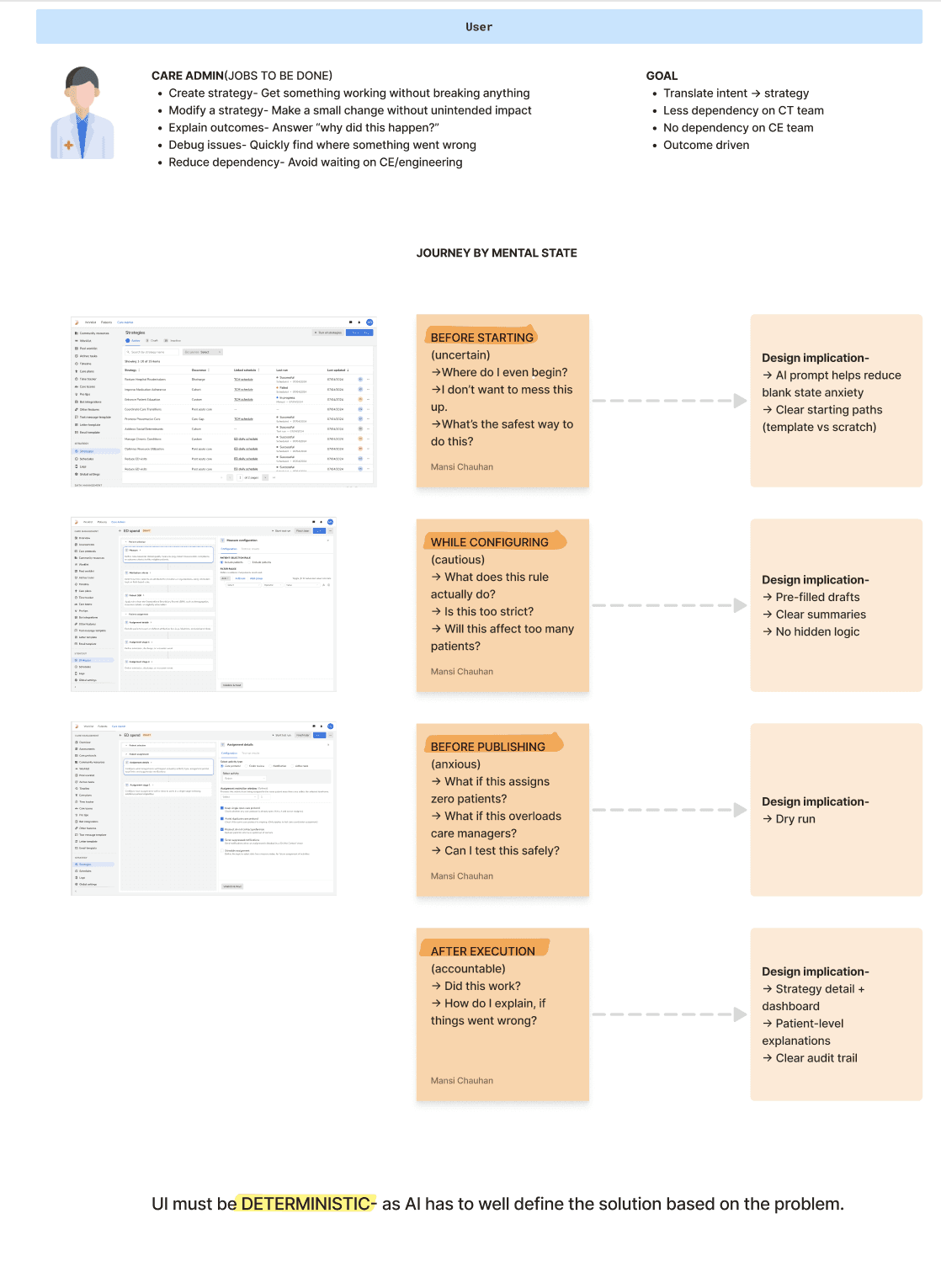
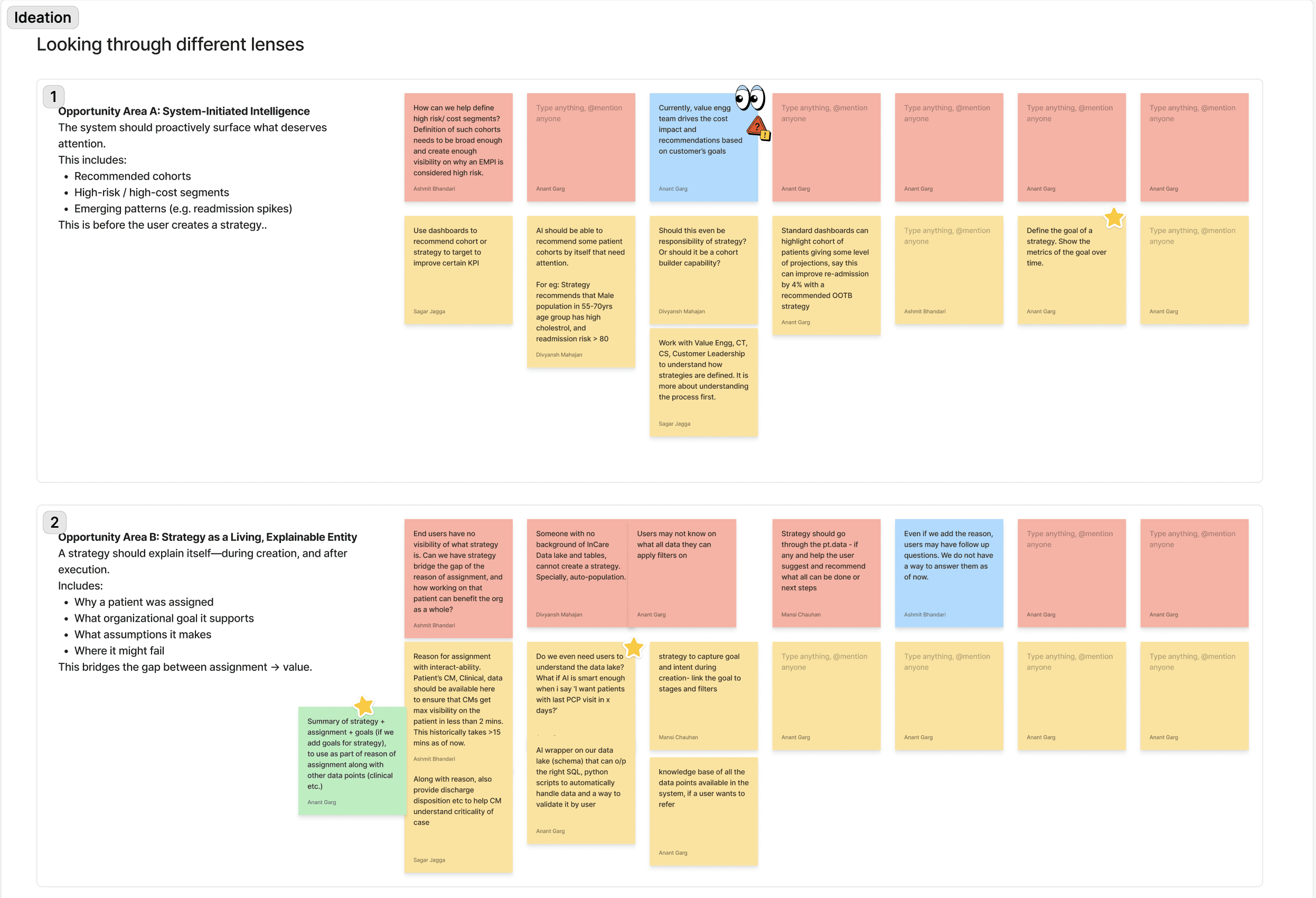
To support how admins decide, I first had to see how they decide today. I shadowed care admins building strategies and traced the JSON tickets and PDFs they'd been sending engineering for months.

The thinking was already happening - just off-platform, in flowcharts and institutional memory.


"I want to share this research with the VP of Design so other teams making AI can use the same framework."
~ Director of Design, after reviewing the AI exploration


"I want to share this research with the VP of Design so other teams making AI can use the same framework."
~ Director of Design, after reviewing the AI exploration

Five observations from that work became five design decisions:

Four ways in, not one.

Four ways in, not one.

Different users arrive in different mental states. Some know exactly what they want. Some need a starting point. Some are reacting to an operational alert. Some are working from organizational patterns.

Read the user's existing thinking.

Read the user's existing thinking.

Care admins were already drawing strategy flowcharts and sending them to engineering as PDFs. I designed the AI to accept those directly as chat attachments - extract the logic, ask clarifying questions, finalize the configuration.

Deterministic behavior, by choice.

Deterministic behavior, by choice.

Same input, same output, every time. In healthcare, an auditor asking "why was this patient assigned?" can't get a different answer next Tuesday. No freeform LLM at runtime.

Finalize the thinking before opening the canvas.

Finalize the thinking before opening the canvas.

The AI scores the prompt, shows what it understood, asks only what's missing (max 4 questions), and presents a tagged Blueprint. The canvas opens only after the user confirms - with every node pre-configured.

Stay inside the lines.

Stay inside the lines.

Every refusal redirects to something productive. "I can't predict outcomes, but I can run a test on current data." "I can't bypass validation - want me to help fix the issues?"

A closed loop, not a one-shot.

A closed loop, not a one-shot.

After a strategy goes live, the AI tracks performance against its KPI and suggests refinements grounded in real data. Create → Publish → Measure → Suggest → Refine.

Built as a working coded product.

Built as a working coded product.

Prototyped in code with Claude in VS Code, integrated with the design system, deployed as a live product. Leadership reviewed it as an interaction, not a mockup.

Impact

Impact

3 months after release of Visual builder

92% Care Admin Activation

Within three months of launch, 11 out of 12 pilot Care Admins independently created strategies using the visual builder. By replacing JSON with a node-based interface, strategy creation became accessible to non-technical users, significantly reducing reliance on Clinical Engineering teams.

4× Increase in Strategies Created

The number of strategies created increased from approximately 4 per month to 18 per month as Care Admins gained confidence using the visual workflow. This indicated stronger product adoption and reduced hesitation around strategy authoring.

68-Minute Median Publish Time

The visual builder reduced the median time required to publish a strategy from up to three weeks- when engineering involvement was required- to 68 minutes, allowing teams to iterate on care programs much faster.

72% Reduction in Support Requests

Support tickets related to strategy creation dropped from 50 to 14 per month, reducing engineering dependency and allowing technical teams to focus on platform improvements rather than manual strategy configuration.

Reflection

Reflection

Reflection

The most important AI design decisions are about what it can't do.

The most important AI design decisions are about what it can't do.

The most important AI design decisions are about what it can't do.

What the AI refuses shaped this product more than what it offers. Every guardrail was a design decision, not a limitation.

Determinism isn't a constraint on AI - it's what makes AI usable in healthcare.

Determinism isn't a constraint on AI - it's what makes AI usable in healthcare.

Determinism isn't a constraint on AI - it's what makes AI usable in healthcare.

Same input, same output, every time. That's not a tradeoff against intelligence. It's the requirement that earns operational trust.

Meet users where their artifacts already are.

Meet users where their artifacts already are.

Meet users where their artifacts already are.

Care admins were already drawing flowcharts. Designing the AI to accept those - instead of asking users to restate their thinking in a chat - was a small choice with the biggest impact.

Close the loop or lose the value.

Close the loop or lose the value.

Close the loop or lose the value.

Most AI products optimize for the first interaction. Designing performance tracking so the AI proves its value over time - not just at the moment of creation - was the move nobody else on the team had considered.

Impact

3 months after release

92% Care Admin Activation

Within three months of launch, 11 out of 12 pilot Care Admins independently created strategies using the visual builder. By replacing JSON with a node-based interface, strategy creation became accessible to non-technical users, significantly reducing reliance on Clinical Engineering teams.

4× Increase in Strategies Created

The number of strategies created increased from approximately 4 per month to 18 per month as Care Admins gained confidence using the visual workflow. This indicated stronger product adoption and reduced hesitation around strategy authoring.

68-Minute Median Publish Time

The visual builder reduced the median time required to publish a strategy from up to three weeks- when engineering involvement was required—to 68 minutes, allowing teams to iterate on care programs much faster.

72% Reduction in Support Requests

Support tickets related to strategy creation dropped from 50 to 14 per month, reducing engineering dependency and allowing technical teams to focus on platform improvements rather than manual strategy configuration.

Next project

Next project

Next project